
Your property tax mentions one municipality, but your mail arrives under the name of another. This discrepancy between cadastral address and postal address affects many property owners, especially in suburban or rural areas. It is not an isolated error, but a structural gap between two referencing systems that were never designed to work together.
Why the cadastral address does not always match the postal address
The cadastral address is managed by the General Directorate of Public Finances (DGFiP). It identifies a parcel within a municipality according to a fiscal breakdown: cadastral section, parcel number, cadastral reference. This system is used to calculate property tax and housing tax.
The postal address, on the other hand, depends on the referencing of La Poste and the National Address Database (BAN). It corresponds to the location where the mail is delivered. The two systems use different geographical logics.
In practice, the same house can fall under one municipality for the cadastre and another for postal delivery. This situation often arises after municipal mergers, territorial redistricting, or reorganizations of postal routes. Detailed resources on this subject are available on the Immobilier 74 website, which describes the concrete situations faced by property owners.
National Addressing Reform: What the 3DS Law of 2022 Changes
The 3DS law of February 21, 2022 initiated a nationwide addressing reform. It requires municipalities to create, update, and ensure the reliability of their addresses to feed into the National Address Database.
The goal is to align three reference systems: the postal address, the cadastral address, and geolocation. The municipality of Falicon, for example, has been working since 2024 on this update to ensure reliable, standardized, and geolocated addresses.

In overseas territories, specific deadlines have been set. In New Caledonia, municipalities with more than 5,000 inhabitants must comply with the addressing obligation by January 1, 2027, while those with fewer than 5,000 inhabitants must do so by January 1, 2028. These deadlines highlight the scale of the project and its urgency for the administration.
This reform directly affects property owners facing a discrepancy between cadastre and postal address: the correction will gradually come from the municipalities themselves.
Concrete Consequences of a Discrepancy Between Cadastre and Postal Address
The problem is not limited to receiving mail under the wrong municipality name. The repercussions affect several areas that property owners often underestimate.
Local Taxation and Property Tax
Property tax is calculated based on the cadastral municipality, not the postal address. If your parcel is fiscally attached to a neighboring municipality, you pay the tax rates of that municipality, even if you benefit from public services from another.
The property tax rate can vary significantly from one municipality to another, creating a gap between the taxation incurred and the services actually used.
Notarial Acts and Property Advertising
During a sale, the notary must identify the property by its cadastral reference (section, parcel number, cadastral municipality). An error in this identification can lead to complications with the property advertising service, or even block the transaction.
A buyer who consults the cadastre online will see the cadastral municipality. If they do not find this information in the real estate listing (which uses the postal address), the confusion can slow down or jeopardize the sale.
Connection to Networks and Building Permits
For a building permit or connection (water, electricity, fiber), the address used by operators is often the postal address. If it does not correspond to the cadastral parcel, the applications may be rejected or processed with delays.
Steps to Correct or Align the Two Addresses
Correcting a discrepancy between cadastral address and postal address requires action with several parties. Here are the steps to follow:
- Contact the town hall of the cadastral municipality to request an addressing certificate (or numbering certificate). This official document certifies that a street number has been assigned to your parcel and will be sent to the DGFiP and the BAN.
- Check the consistency of your address on the cadastre website (cadastre.gouv.fr) and on the National Address Database. If the information diverges, report the discrepancy to the town hall.
- For postal delivery, submit a request to La Poste if your mail arrives under an incorrect municipality name. The update of the BAN by the town hall normally leads to an automatic correction on the postal side.
- In the case of a sale or notarial act, provide the notary with the exact cadastral reference (section and parcel number) to avoid any errors in the property advertising.
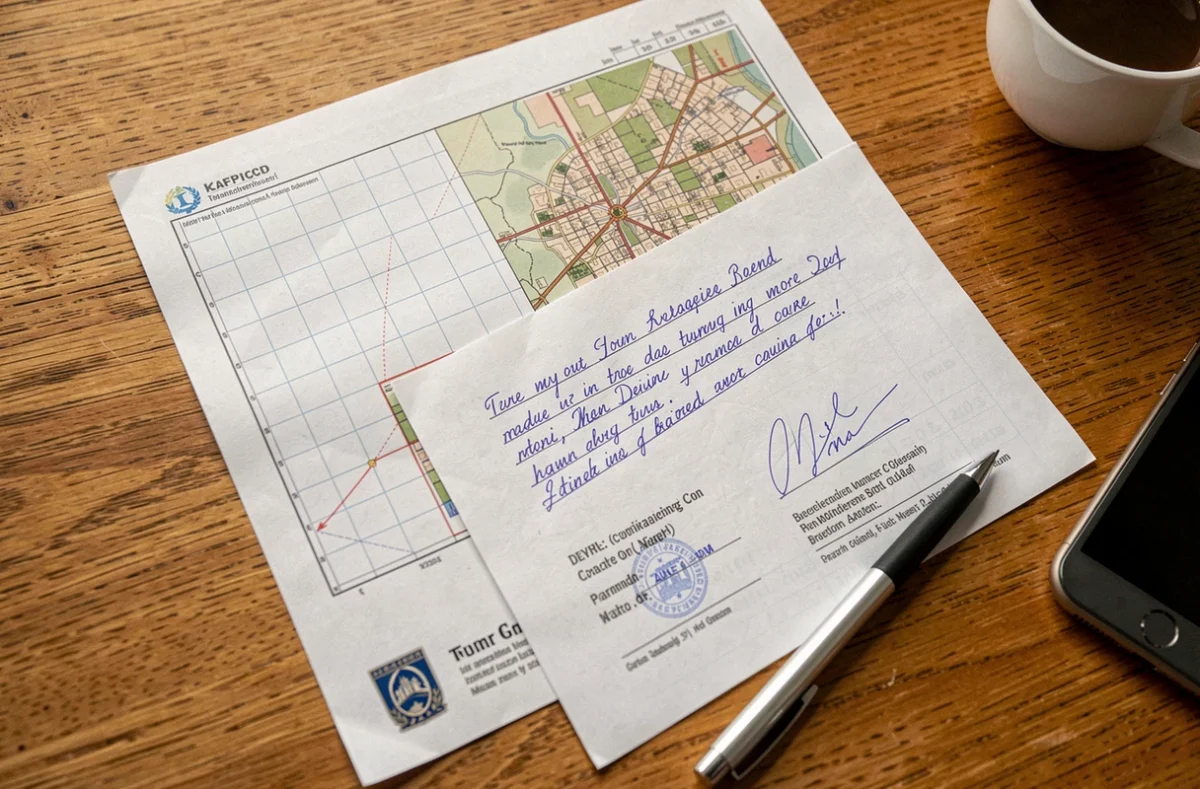
The addressing certificate should not be confused with the address certificate. The former concerns the territory (assignment of a street number to a parcel), while the latter concerns the resident (proof of residence). To correct a cadastre/post discrepancy, it is indeed the addressing certificate issued by the town hall that should be requested.
Real Estate Sale and Transparency on the Cadastral Municipality
During a transaction, the postal address and the cadastral municipality appear in different documents. The listing uses the postal address, the sales agreement mentions the cadastral reference, and the authentic deed must include both without ambiguity.
A property owner selling a property located in a cadastral municipality different from the postal address has every interest in signaling this as soon as the property is put up for sale. Transparency regarding the cadastral municipality avoids blockages at the notary and reassures the buyer about the consistency of the property information.
The DVF (Demandes de Valeurs Foncières) data and online estimates are based on the cadastral municipality. A property listed under an attractive postal address but fiscally attached to a neighboring municipality may display a price per square meter different from what the buyer expects.
The addressing reform initiated since 2022 should gradually reduce these discrepancies. In the meantime, cross-checking between cadastre, BAN, and postal address remains the most reliable precaution before any administrative process or real estate transaction.