
A dog that has grown up from a young age in the company of cats naturally develops a relaxed attitude: the felines become part of its daily life, neither a mystery nor a threat. However, when an adult cat encounters the sometimes exuberant sound world of a dog for the first time, nervousness often creeps in. Even the easiest-tempered animals can fall into this equation; even the most placid of creatures may devise their own tactics to maintain control of their territory or isolate themselves at the slightest alert.
Establishing a true coexistence is not a matter of chance or a magic recipe. It begins with an intelligent sharing of resources, a careful reading of animal language, and a space arrangement designed for a smooth evolution. Conflicts often stem from a too-rapid start or a misunderstanding of the specifics of each species.
You may also like : Discovering Senior Life: Tips, Testimonials, and Tricks for Aging Well
Why dogs and cats struggle to understand each other: focusing on their codes
The cohabitation between dogs and cats remains a sometimes strange exercise, where humans must relearn to observe their companions. The dog lives for the pack: everything is conveyed through gestures, voice, and group energy. The cat, on the other hand, favors discreet signals, silence, and its jealously cultivated independence.
It is difficult to align these two worlds without clashes. A dog wagging its tail communicates joy, while a cat swishing its tail signals irritation. When a puppy approaches with its nose outstretched, it believes it is inviting play; the cat may perceive it as aggression. Temperaments add another layer: some breeds of dogs that are exuberant or certain breeds of cats that are very territorial amplify these discrepancies.
See also : How to Choose the Right Car: Tips and Tricks for a Successful Purchase
To shed light on these subtleties, the site Comme Chien & Chat offers resources from animal ethology that help better interpret the postures and signals shared between dogs and cats.
To limit misunderstandings and adjust one’s posture, it is beneficial to consider the following points:
- Observe the body codes and vocalizations specific to each species
- Respect the need for distinct personal spaces, especially during initial meetings
- Adapt the pace of introductions according to each animal’s sensitivity
Weaving a peaceful relationship between these two worlds requires patience, listening, and recognition of the most fundamental differences.
Initial exchanges: how to lay the groundwork for a peaceful meeting
The initial step plays a crucial role in what follows. It’s better to take your time: give the cat the opportunity to isolate itself in a high place or in a room reserved for it, inaccessible to the dog, where it can observe and catch its breath. Before any meeting, familiarize each animal with the other’s scent by exchanging blankets, cushions, or toys. This indirect approach prepares the ground and limits tension.
When the real face-to-face encounter occurs, choose a neutral location. Keep the dog on a leash and let the cat manage the distance. Some may prefer to explore before approaching, while others will want to meet immediately: the important thing is to never force it. Remain observant. If tension rises, redirect attention and offer distractions.
To structure the experience, adhere to some useful guidelines:
- Set up refuge spaces for the cat: height, hiding spots, cat trees
- Establish progressive steps: short sequences, then longer ones, depending on each animal’s comfort
- Remember that successful dog-cat coexistence is a long-term endeavor, never a rushed one
<p.It is in these small concessions and constant attention that the duo's trust is forged, a solid foundation for all the shared life to come.
In daily life: promoting balance and anticipating tensions
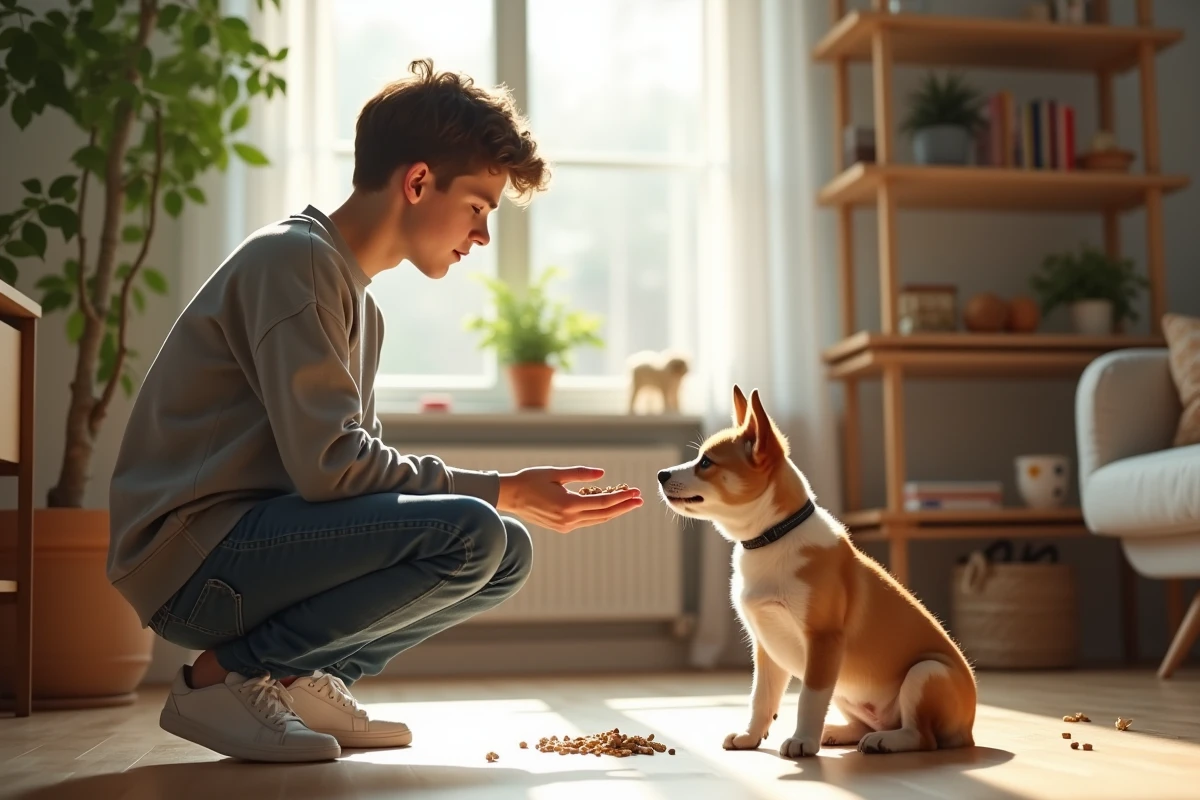
Harmonious coexistence is not improvised; it is built through the repetitive gestures of daily life. Provide each with well-separated resource spaces:
- A feeding area reserved for each animal
- The cat’s litter box out of the dog’s reach
- Resting places suited to their natural preferences
The cat draws its confidence from height, on a shelf or perch; the dog claims the space on the ground. This management of volumes calms the shared territory.
Also, remember to regularly renew blankets, fabrics, and scent supports. Scents are reassuring, but their mixing should be done gradually; do not disturb their markers too quickly. Stay attentive to each interaction: if the dog becomes overly excited, or if the cat seems defensive, intervene gently, offer a toy, take a break.
Some habits reinforce peace:
- Structured play sessions tailored to each temperament
- Respecting the cat’s quiet times: do not disturb it during its naps
- Physical exercise for the dog, outdoors whenever possible
Day after day, coexistence becomes smoother. Here, there is no search for a forced fusion, just the desire to give each animal the opportunity to thrive in the shared home. Accepting their differences is the key that transforms coexistence into balance, sometimes fragile, but precious.