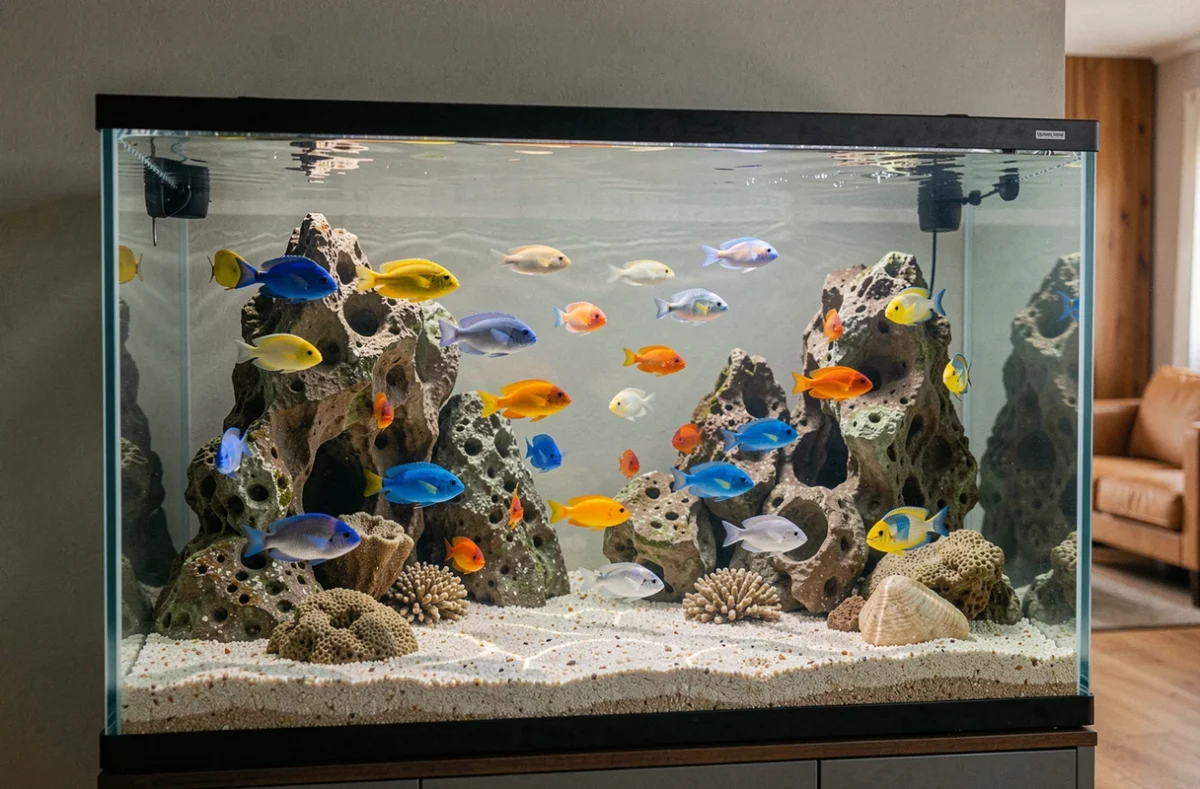
Cichlids form one of the most diverse families of freshwater fish in the world, with requirements that vary greatly from one species to another. Properly housing these fish in an aquarium involves going beyond the simple question of volume to consider how the decor, water chemistry, and social structure interact on a daily basis.
Decor and Social Behavior of Cichlids in the Aquarium
Most guides focus on the number of rocks or caves to place in the tank. The angle that deserves more attention concerns the effect of the decor on dominance relationships among fish.
A study published in Animal Welfare (Cambridge University Press, September 2026) shows that the complexity of the layout can alter the physiological differences between dominant and subordinate individuals. Decor that can be easily monopolized by a single fish tends to accentuate hierarchies, which generates chronic stress in subordinate individuals.
Specifically, an aquarium of African cichlids adorned with a few large rocks forming a single refuge area primarily benefits the dominant male. Increasing broken lines of sight, narrow passages, and shelters distributed throughout the tank allows subordinate fish to escape aggression. To delve deeper into housing on CICH Lidae, this logic of distributed layout serves as a good starting point.
Thus, the decor does not only serve to replicate a biotope: it regulates social pressure within the tank.
Artificial Plants and Enrichment of the Cichlid Tank
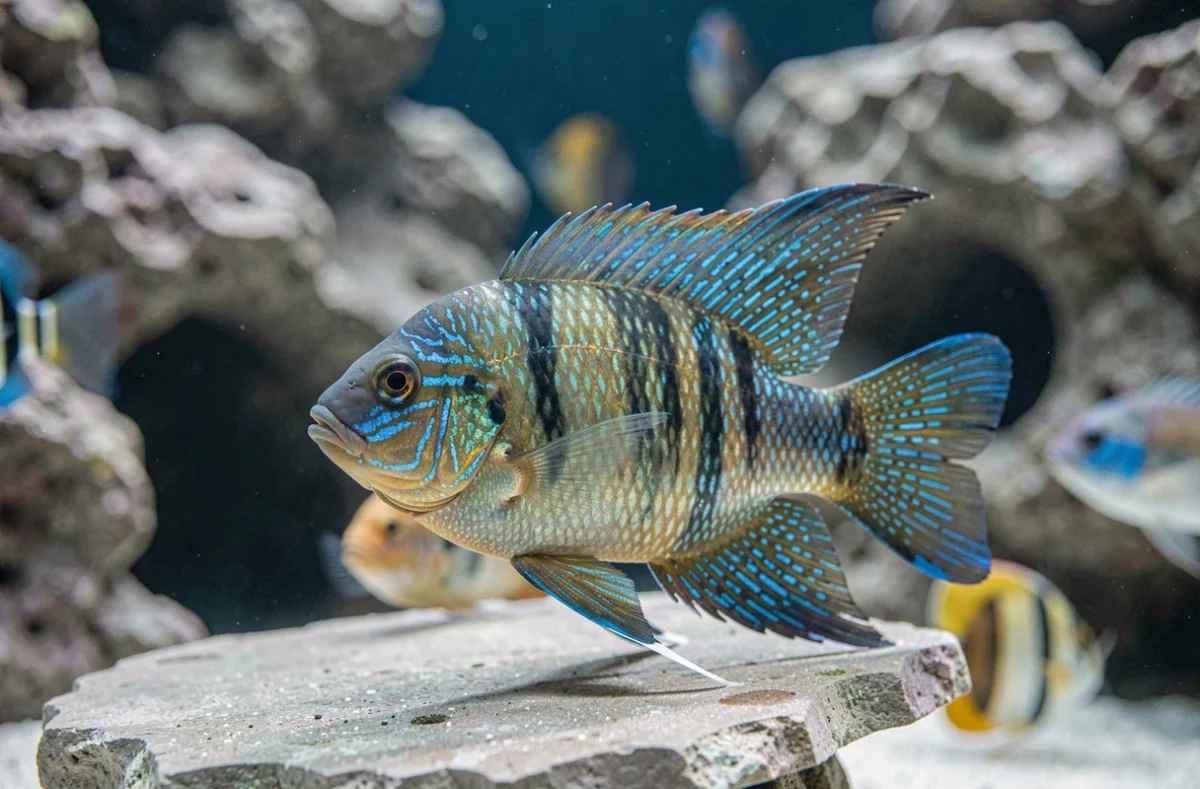
Cichlids from Lake Malawi or Tanganyika naturally live in rocky environments where plants are scarce. Many aquarists therefore exclude any vegetation, whether real or artificial. The work of Burka, Oldfield, Kelty, and Dijkstra, published in Applied Animal Behaviour Science (volume 305, 2026), nuances this approach.
Their study on Astatotilapia burtoni indicates that the presence of artificial plants in breeding areas could reduce mortality. However, no significant improvement in growth, body condition, or fin integrity has been demonstrated.
This result calls for caution: adding decorative elements does not automatically enhance well-being. Enrichment must be evaluated on a case-by-case basis, observing the actual behavior of the fish rather than applying a one-size-fits-all recipe.
Volume and Population: Sizing a Cichlid Aquarium
The volume of the tank remains the primary limiting factor. Mbuna-type species from Lake Malawi, territorial and active, require a tank whose front length allows for the establishment of several distinct territories. A tank that is too short, even if it contains enough liters, concentrates aggressive interactions over a reduced area.
Criteria to Consider Before Choosing the Population
- The adult size of each species, which determines the minimal territorial space. A pair of dwarf cichlids does not have the same needs as a group of Mbunas.
- The male/female ratio: for polygamous species from Malawi, maintaining one male for several females limits excessive chasing.
- Chemical compatibility: species from Malawi and Tanganyika tolerate hard, alkaline water, while South American cichlids (Apistogramma, Discus) prefer softer, more acidic water. Mixing the two biotopes in the same tank creates a compromise that is unfavorable to all.
Field reports vary on the exact ratio of liters per fish, as the shape of the tank and filtration play a role just as crucial as the gross volume. A tall and narrow tank with a large capacity may prove less suitable than a more modest but elongated tank.
Quarantine and Hospital Tank: A Permanent Setup for Cichlids
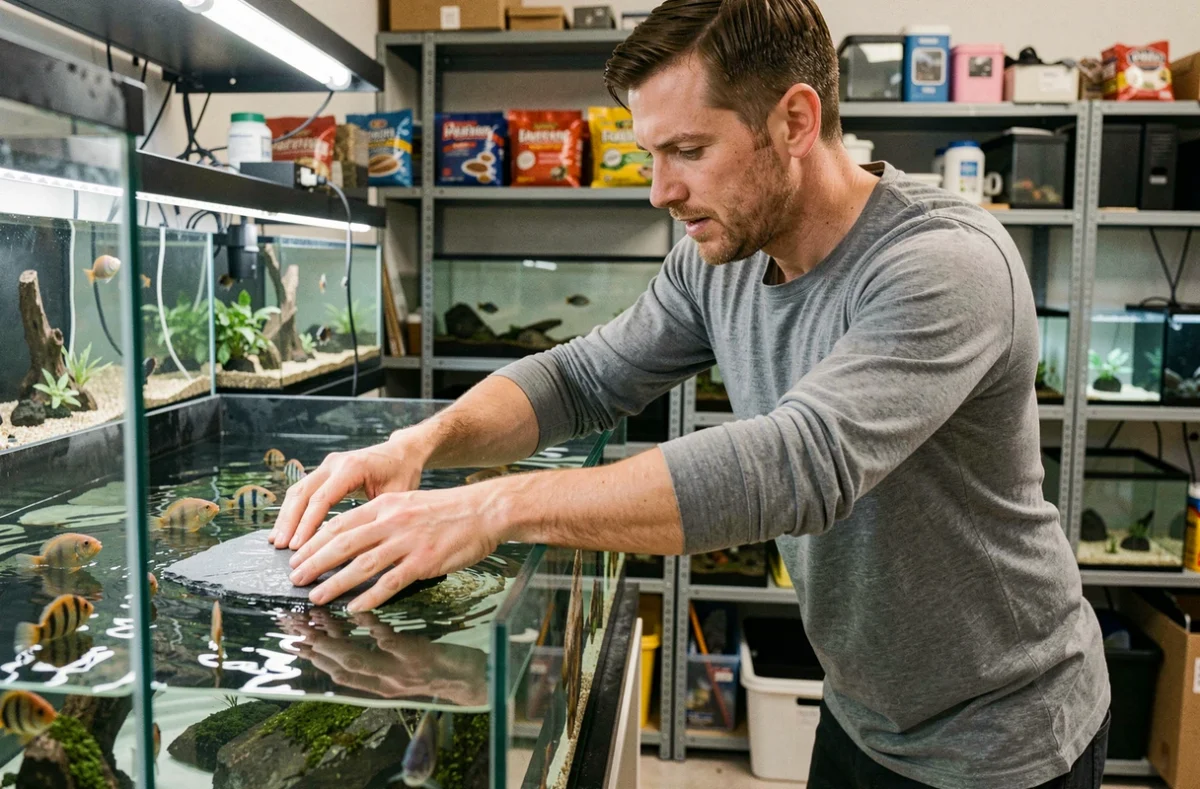
Quarantine is often reduced to a one-time step before introducing a new fish. Specialized sources consulted in 2026 recommend maintaining a separate hospital tank permanently, not just during purchases.
Cichlids are sensitive to several pathologies (Malawi bloat disease, bacterial infections, gill parasites) that can remain latent for weeks. A dedicated quarantine tank allows for:
- Quickly isolating a fish showing signs of stress or illness, without disturbing the social balance of the main tank.
- Treating with medications without exposing the bacteria in the main biological filter, whose colony can be destroyed by certain products.
- Observing newcomers for a sufficient duration before integrating them into an established population, during which power dynamics are redefined.
On the regulatory side, when no appropriate medication is authorized for a given species and condition, a veterinarian can apply the cascade prescription. A product sold without a prescription may then require a prescription in this specific context. Having a hospital tank facilitates the implementation of these treatments without improvisation.
Parameters of the Quarantine Tank
The water in the hospital tank must replicate the parameters of the main tank (temperature, hardness, pH) to avoid osmotic shock during transfer. A small sponge filter is sufficient to maintain the nitrogen cycle without creating too strong a current, which limits stress for recovering fish.
Properly housing cichlids goes beyond the question of volume and the number of species. The structure of the decor modifies social relationships, enrichment does not produce the same effects depending on contexts, and permanent quarantine remains one of the most cost-effective investments for the health of the tank. These elements, often overlooked in favor of purely aesthetic considerations, make the difference between a functioning aquarium and a tank where losses accumulate.