
The 5G coverage in France involves four operators whose national scores are getting closer year by year. Comparing Orange, SFR, Bouygues Telecom, and Free in this area requires distinguishing what each ranking measures: geographical coverage of the territory, population reached in mobility, or actual service quality. The gaps, once significant, are now counted in fractions of points.
nPerf 5G Coverage Score: The Comparative Table of the Four Operators
The nPerf barometer calculates an overall score by combining two indicators equally: geographical coverage (territory area) and the population covered in mobility. For the period from September 2025 to August 2026, the results are as follows.
| Operator | 5G Geographical Coverage | Population in Mobility | Overall nPerf Score |
|---|---|---|---|
| SFR | 58.62 % | 86.94 % | 72.78 % |
| Bouygues Telecom | 57.25 % | 87.44 % | 72.34 % |
| Free | 54.49 % | 88.61 % | 71.55 % |
| Orange | 55.46 % | 87.55 % | 71.51 % |
Only 1.27 points separate the first from the last in this ranking. This near-equality contrasts with past gaps, which exceeded 11 points between the best and worst-performing operators.
As shown by the 5G comparison by Insomnie du Geek, the reading of the overall score masks very different deployment profiles depending on the operators.
Geographical Coverage vs. Population in Mobility: Two Rankings, Two Winners

The table reveals a paradox. SFR has the best geographical coverage but the lowest score on the population in mobility. Free presents exactly the opposite profile: last in terms of covered area, it ranks first in terms of the population reached during travel.
This inversion can be explained by frequency choices. Free has heavily used the 700 MHz band for its 5G deployment. These low frequencies cover long distances and penetrate buildings better, which enhances population coverage in dense areas.
In contrast, the 3.5 GHz band, more utilized by Orange and SFR at certain sites, offers higher capacity and speeds but has a shorter range. An operator can therefore show extensive territorial coverage without the user experience in terms of speed being up to par.
What Geographical Coverage Doesn’t Tell You
Covering a portion of the territory does not mean providing a high-performance service there. Low frequencies, while extending coverage on the map, generally offer less capacity and speed than the 3.5 GHz band. A comparison limited to the number of sites or covered area can therefore overestimate the actual experience of a subscriber.
Arcep also distinguishes several indicators in its measurements: population coverage, territory coverage, but also call quality, data quality, and mobility usage (road and rail journeys). These dimensions do not always overlap.
5G Network Quality: Orange and the Speed Factor
The quality of service data published by Arcep and independent speed tests paint a different picture from the simple coverage ranking. Orange maintained a clear advantage in quality in rural areas and in mobility, despite slightly lower overall geographical coverage than SFR.
In practical terms, Arcep’s measurements are not limited to the presence of a 5G signal. They also assess the reliability of calls, web browsing, and video streaming. On these qualitative criteria, Orange and Bouygues Telecom regularly stood out.
Frequencies and Speed: The Key to Understanding
The theoretical speed directly depends on the frequency band used on each antenna. Here are the three main scenarios for 5G in France:
- The 700 MHz band: long range, good indoor penetration, but speed comparable to a high-performing 4G+. Preferred by Free for its rapid deployment.
- The 3.5 GHz band: spectrum dedicated to 5G, significantly higher speeds, but shorter range. Used in urban and suburban sites by Orange, SFR, and Bouygues Telecom.
- The 2.1 GHz band: a compromise between range and capacity, reallocated to 5G by some operators to complement their network.
A 5G plan does not guarantee high 5G speeds if the local antenna operates at 700 MHz. Checking the available frequency at one’s address remains the only way to know what coverage really means.
Local 5G Coverage: Why the National Ranking Is Not Enough
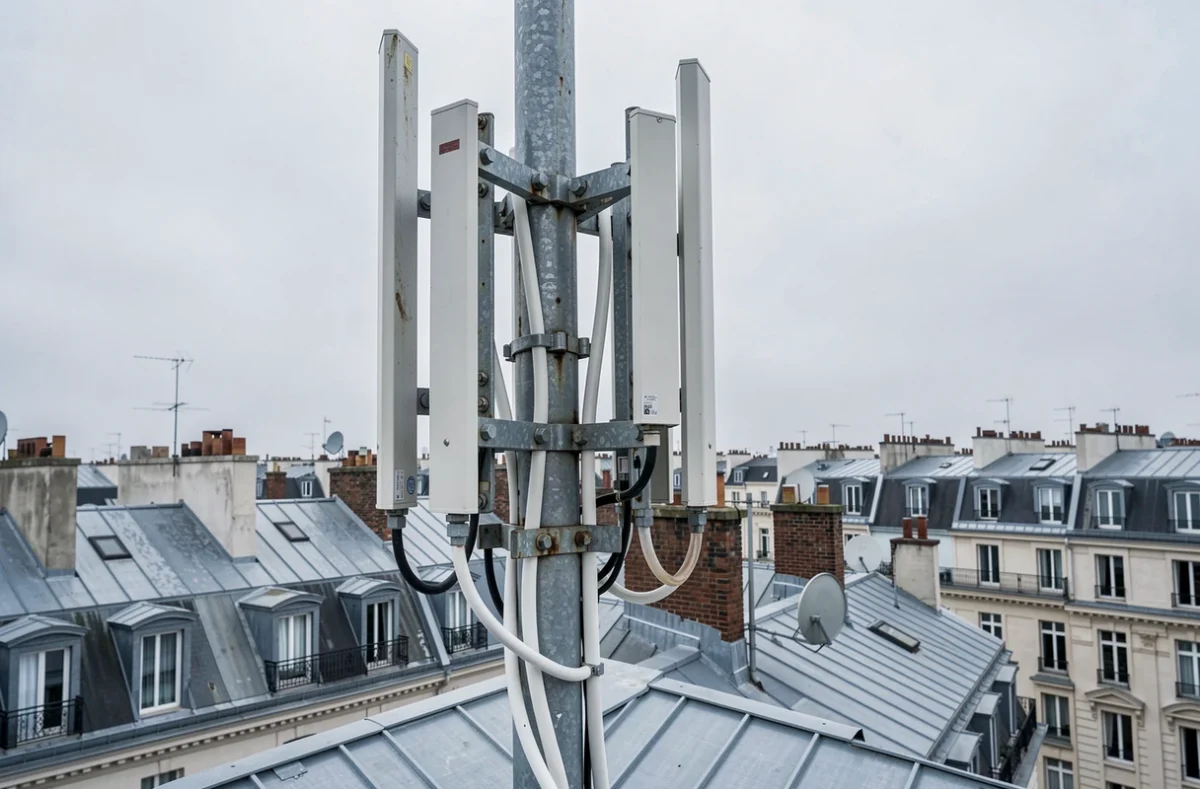
National averages smooth out considerable regional disparities. An operator that ranks first nationally may be absent or underperforming in a given department.
Arcep provides mobile coverage maps by department, which allow for visualizing the actual availability of each network. These data show that the near-national equality disappears as soon as local coverage is observed.
Three factors explain these variations:
- The terrain and vegetation density, which attenuate the signal of higher frequencies more quickly.
- The density of antennas installed by each operator in a given area, which varies according to deployment priorities.
- Urban planning permissions and installation delays, which create discrepancies between operators depending on the municipalities.
A subscriber in a rural or suburban area has every interest in consulting Arcep’s maps or coverage testing tools before choosing their operator, rather than relying on the national score.
The four French operators now display almost identical 5G coverage scores at the national level. The difference lies in two axes that global rankings do not capture: the frequency actually used on the local antenna and the quality of service measured under real conditions. Checking coverage at one’s precise address remains the only reliable indicator for choosing between Orange, SFR, Bouygues Telecom, and Free.