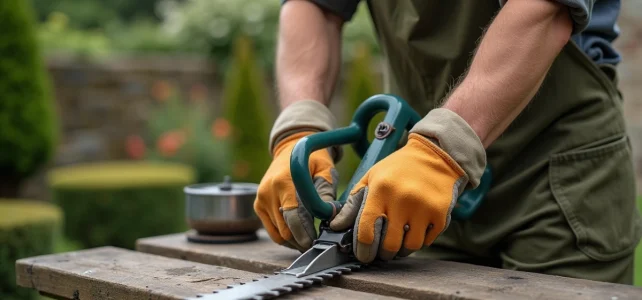
A hedge trimmer blade that tears branches instead of cutting them leaves open wounds on the plant. These injuries facilitate the entry of fungi and pests, weakening the hedge in the long term. Knowing how to sharpen a hedge trimmer blade correctly protects both the tool and the shrubs, and the technique varies depending on the type of blade and the vegetation being trimmed.
Blade coatings and sharpening frequency: what really changes
Mid-range and high-end hedge trimmers now feature blades coated with PTFE, nickel, or hard chrome. These surface treatments reduce sap adhesion and slow down the wear of the cutting edges. According to Stihl product sheets (France catalog 2024) and the Husqvarna 522HDR60X manual (2023 edition), these coatings extend the interval between two sharpenings.
You may also like : How to Choose the Right Gardening Equipment for a Impeccable Outdoor Space
The downside is significant: only manual abrasives (flat file, stone) preserve the coating. An angle grinder, even used briefly, destroys the protective layer and nullifies the benefit of the treatment. Therefore, before using an abrasive tool, check if your blades are coated. This information is found on the technical sheet or directly on the blade.
For those who wish to delve deeper into the maintenance logic of garden cutting tools, knowing how to sharpen a hedge trimmer blade also applies to string trimmers and brush cutters, which share the same manual sharpening principles.
Related reading : Practical tips for securely fixing a kitchen wall cabinet to drywall

Cutting angle suitable for species: a distinction ignored by most guides
General public guides recommend a single angle for sharpening. Recent manufacturer manuals tell a different story. The Makita DUH602Z manual (2023 revision) and the Stihl HLA 86 manual (2023 edition) explicitly distinguish the angle according to the type of vegetation.
Soft hedges and hardwood hedges
For hedges of privet, thuja, or young boxwood, the manufacturer’s original angle (often close to 30°) is suitable. The fibers are soft, and the blade penetrates without forcing.
For hardwood species such as hornbeam, mature cherry laurel, or hawthorn, manufacturers recommend a slightly obtuse angle (greater than 30°). A too-fine edge chips quickly on dense wood, which necessitates more frequent sharpening and weakens the geometry of the tooth.
In practical terms, this means that the same hedge trimmer used on two different types of hedges should not be sharpened in the same way. Field feedback varies on this point, as many gardeners apply a standard angle without adapting, then notice premature dulling on hard species.
Sharpening with a flat file: technique tooth by tooth
The flat file remains the most reliable tool for sharpening a hedge trimmer blade. It allows for control of pressure and angle on each tooth, which no powered tool can guarantee with the same precision.
Preparation before sharpening
- Unplug the device or remove the battery. On a gas model, disconnect the spark plug to eliminate any risk of accidental starting.
- Clean the blade with a wire brush or a cloth soaked in solvent to remove dried sap and plant residues. Accumulated sap distorts the perception of sharpness and prevents the file from biting properly.
- Secure the hedge trimmer in a vise or on a stable workbench, with the blade accessible and well-lit. Wear protective gloves suitable for working with sharp edges.
Filing motion and consistency
Place the file flat against the existing bevel of the tooth. Always work in the direction of the edge, from the base to the tip, in a steady motion. Count the same number of passes on each tooth to maintain uniform geometry across the entire blade.
Excessive pressure is counterproductive. The file should remove a minimum of material with each pass. Two or three light passes per tooth are sufficient in most cases. If a tooth resists or shows a visible chip, it may require replacement rather than forced sharpening.
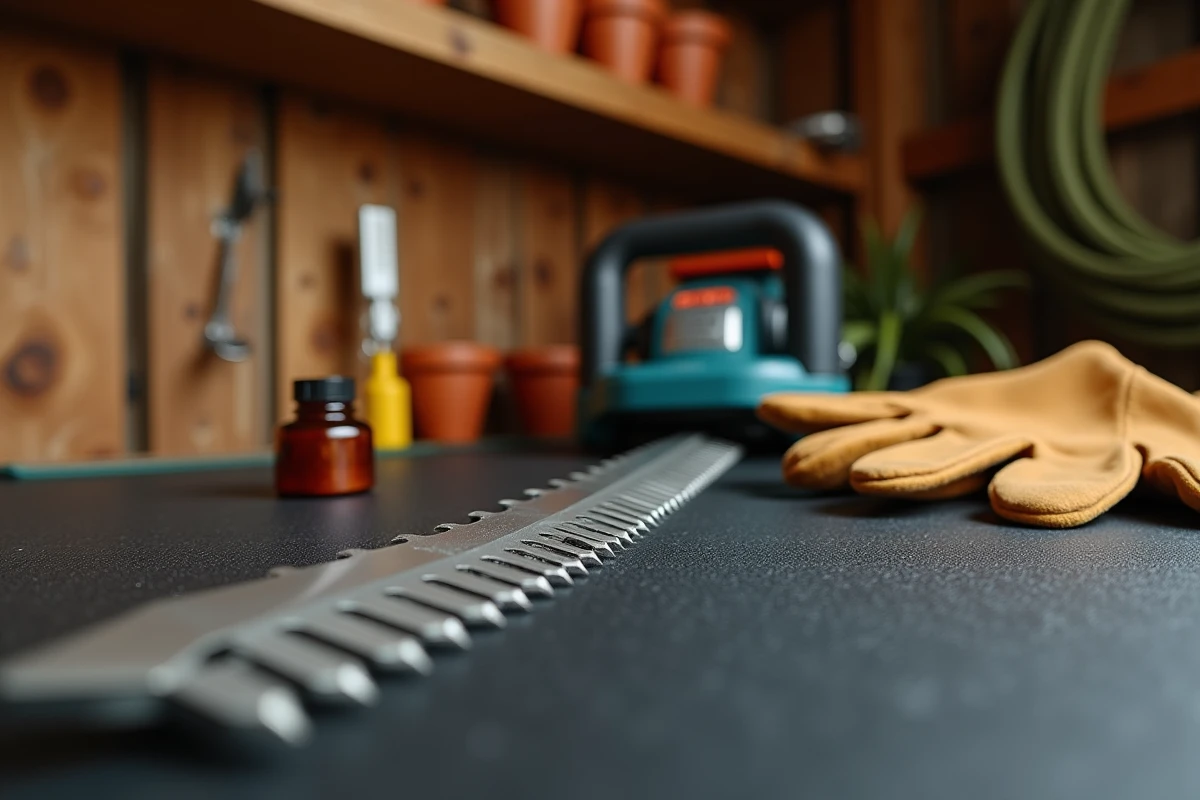
After treating all the teeth on one side, flip the blade and repeat the operation on the other side. Asymmetrical sharpening degrades cutting quality and causes uneven heating during use.
Sharpening stone or file: which sharpening tool for which result
The sharpening stone (diamond stone or ceramic stone) produces a finer edge than the file, but it requires more skill. It is suitable for light maintenance between two complete sharpenings or for blades that are not heavily damaged.
The flat file, on the other hand, removes more material and corrects small chips. It remains the reference tool for complete sharpening of the blade.
- Sharpening stone: routine maintenance, finishing the edge, suitable for coated blades if the grit is fine.
- Flat file: foundational sharpening, correction of dull or slightly chipped teeth, precise angle control.
- Angle grinder: to be avoided on hedge trimmers. The risk of overheating softens the steel and destroys coatings. Some professionals use it on uncoated blades, but the margin for error remains low.
Post-sharpening maintenance and corrosion protection
Once sharpening is complete, wipe a clean cloth over the entire blade to remove metal particles. Then apply a thin layer of oil or protective spray on both sides of the blade. This step limits oxidation between uses and reduces friction during the next trimming session.
Store the hedge trimmer with a protective sheath over the blade. A shock to a freshly sharpened tooth is enough to create a chip that compromises the clean cut sought.
Regular sharpening of a hedge trimmer requires neither expensive equipment nor knife skills. A flat file, adherence to the angle suitable for your species, and a few minutes of cleaning after each trimming session keep a blade performing well for several seasons.